
A Clear Framework for Project Governance
Complex projects require clear roles, clear decision-making and a shared understanding of who needs to be involved at each level.
The Governance Triangle provides a practical way to define the governance bodies supporting a project, clarify their responsibilities and establish how communication and decisions move across the organization.
Governance Triangle
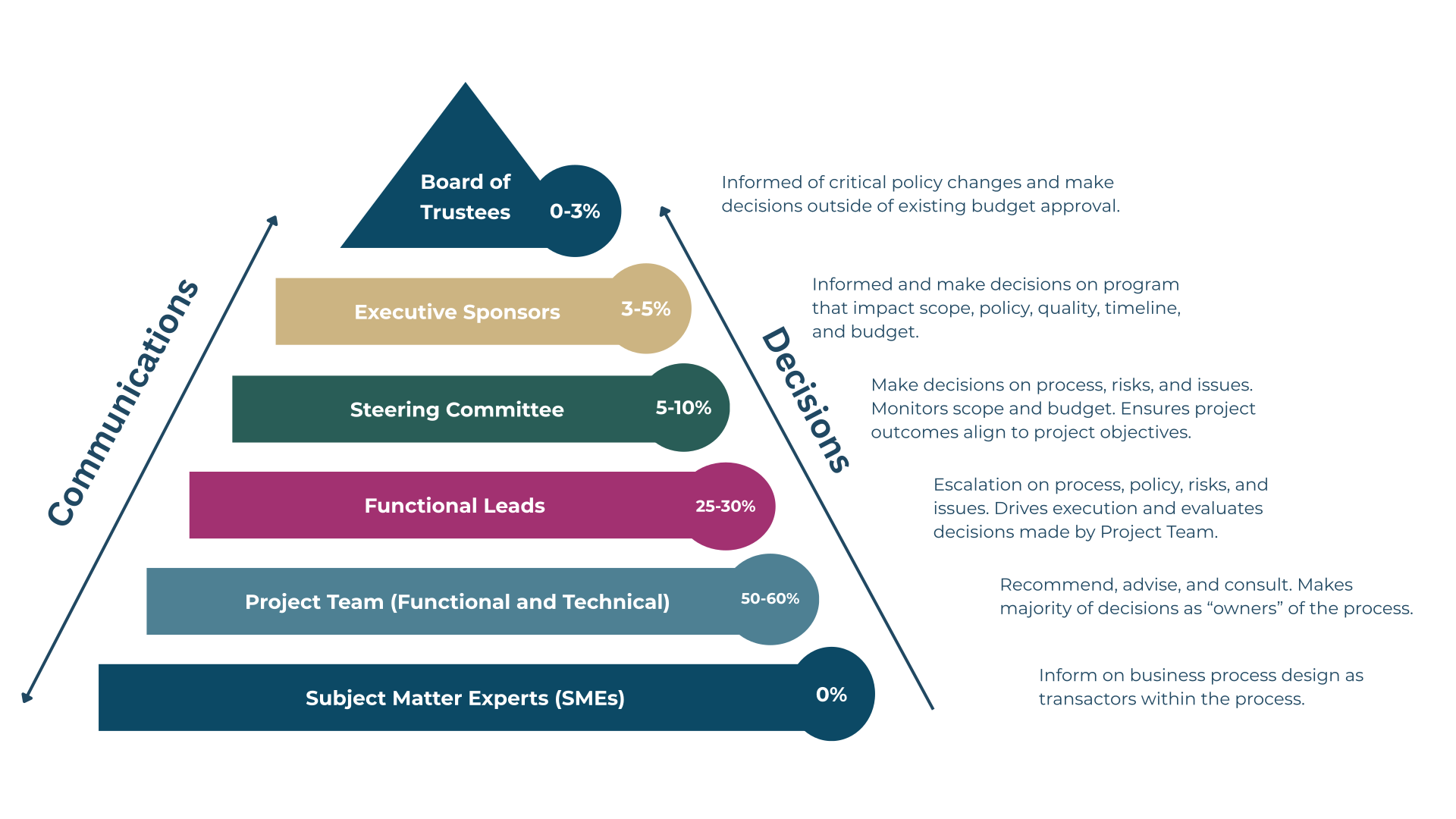
The Program Management Office (PMO) is a cross functional group, responsible for oversight, facilitation and coordination between each governance body.
The framework includes six levels of project governance, from the Board of Trustees through the Project Team and Subject Matter Experts, with defined levels of involvement for each group.
How to Read the Governance Triangle
Board of Trustees | 0–3%
The Board of Trustees is informed of critical policy changes and makes decisions that fall outside of existing budget approval.
Executive Sponsors | 3–5%
Executive Sponsors are informed and make decisions on program matters that impact scope, policy, quality, timeline and budget.
Steering Committee | 5–10%
The Steering Committee makes decisions on process, risks and issues. It monitors scope and budget and helps ensure project outcomes align with project objectives.
Functional Leads | 25–30%
Functional Leads handle escalation related to process, policy, risks and issues. They drive execution and evaluate decisions made by the Project Team.
Project Team | 50–60%
The Project Team includes functional and technical team members. They recommend, advise and consult while making the majority of decisions as owners of the process.
Subject Matter Experts | 0%
Subject Matter Experts inform business process design as transactors within the process.
Where the PMO Fits
The Program Management Office sits across the governance structure rather than within a single level.
The PMO is a cross-functional group responsible for oversight, facilitation and coordination between each governance body.
Communication and Decision-Making
The Governance Triangle is designed to make two things visible: communications and decisions.
By defining the governance structure at the outset of a project, teams can create greater clarity around who needs to be informed, who is responsible for moving work forward and where key decisions belong.
Applying the Governance Triangle to Workday
Workday implementations require coordination across executive leadership, functional teams, technical teams, and subject matter experts. Establishing governance early helps clarify where decisions are made, how issues are escalated and how each group contributes throughout the implementation.
Put the Framework to Work
Clear governance helps create alignment before issues, risks and decisions begin moving through a project.